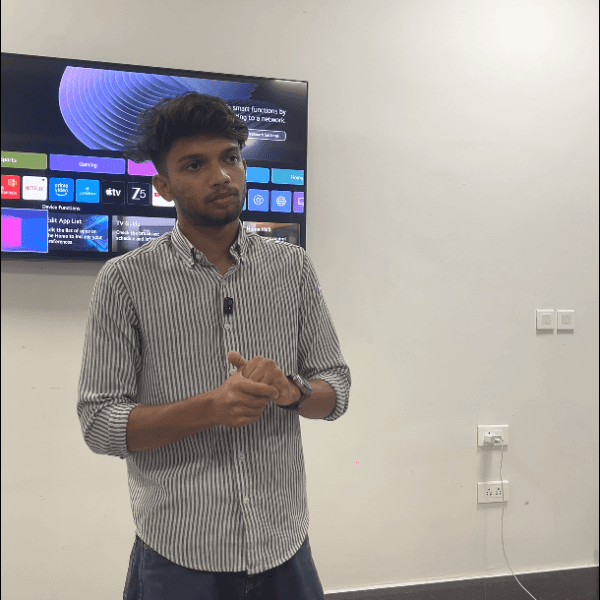
From working events for ₹400 a day to running his own event company and launching a nostalgic snacks brand — Anas is building two businesses at once.
What he is building: Two ventures — an event management company handling weddings and corporate events across Kerala, and RETRO RUCHI (retroruchi.com), an ecommerce store selling nostalgic Kerala snacks including Kozhiada, Sweet Feed, and Bala Bite.
What he is building: Two ventures — an event management company handling weddings and corporate events across Kerala, and RETRO RUCHI (retroruchi.com), an ecommerce store selling nostalgic Kerala snacks including Kozhiada, Sweet Feed, and Bala Bite.
Anas had revenue, real experience, and two businesses running — but no system, no focus, and no clarity on where to grow next. He joined EDEAS to build the structure that his hustle alone couldn't give him.
Anas had revenue, real experience, and two businesses running — but no system, no focus, and no clarity on where to grow next. He joined EDEAS to build the structure that his hustle alone couldn't give him.
Before the Program
What he did before this:
Anas's business instinct started young. From Class 5, he watched his father run a bakery and was drawn to every part of it — but was always told to go study instead. By Class 9, he was quietly managing operations on his own. By Plus Two, he had grown the family's two shops to four.
Then came a reset. A family disagreement led to his account being frozen — the savings he had built up, gone overnight. He went from four shops to zero. Rather than give up, he used it as a starting point. He took his first event job earning ₹400 a day, spotted how the money was being split unfairly, and eventually started his own event company with school friends from Kuttippuram.
By the time he joined EDEAS, he had completed his BBA degree, was running his event management company solo, earning around ₹1 lakh per month in revenue, and was also in the process of building RETRO RUCHI — an ecommerce store for nostalgic Kerala snack brands.
What he was earning before joining: ~₹1 lakh/month from event management
Why he needed structured mentorship:
He started a parallel venture — Retro Ruchi, a nostalgic snacks brand — while his event business still needed fixing. IIDT Escala's philosophy is clear: running two businesses without mastering one first isn't ambition, it's distraction. This is one of the first things the mentors addressed.
What he was missing before joining:
A clear USP, focus on one event category, proper financial tracking per event, and a system to scale rather than just hustle harder.
The Journey So Far
Month 1 — May 2026
What he focused on this month: Understanding where his event business actually stands — by numbers, not by feel.
Challenges:
No clear USP — currently takes any event in any category, making it hard to build expertise, referrals, or a reputation in one area. Stage décor alone typically consumes ₹25,000 out of a ₹30,000 sub-vendor budget, with Anas retaining only around ₹5,000. The numbers are unclear until properly broken down.
Key actions taken:
As a starting point from his first EDEAS mentor session, Anas was assigned to pull data from his last 30 events — breaking down revenue, total expenses, and sub-vendor costs (staging, lighting, décor, etc.) per event to understand where the margins are actually going. He was also asked to collect structured feedback from previous clients to identify patterns in what clients valued most about working with him.
Biggest learning this month:
Running multiple categories doesn't build a business — it builds a habit of starting over every week. Focus is not a luxury. It's the business.
Month 1 — May 2026
What he focused on this month:
Understanding where his event business actually stands — by numbers, not by feel.
Challenges:
No clear USP — currently takes any event in any category, making it hard to build expertise, referrals, or a reputation in one area. Stage décor alone typically consumes ₹25,000 out of a ₹30,000 sub-vendor budget, with Anas retaining only around ₹5,000. The numbers are unclear until properly broken down.
Key actions taken:
As a starting point from his first EDEAS mentor session, Anas was assigned to pull data from his last 30 events — breaking down revenue, total expenses, and sub-vendor costs (staging, lighting, décor, etc.) per event to understand where the margins are actually going. He was also asked to collect structured feedback from previous clients to identify patterns in what clients valued most about working with him.
Month 2 — June 2026
What he focused on this month::
Key actions taken:
Challenges:
Key actions taken:
Month 3 — July 2026
What he focused on this month::
Key actions taken:
Challenges:
Key actions taken:
The Honest Challenge
Anas came into EDEAS with genuine momentum — but also with a genuine problem that needed to be named clearly.
Problem 1 — No USP, no category: His Events Business takes any event from anyone. Weddings, colleges, corporates, birthdays, hospital anniversaries. The result: the team cannot be trained for any single type. Pricing cannot be standardised. The brand cannot be marketed. Clients cannot refer you clearly because they don't know what you specialise in.
Problem 2 — Two businesses without one being fixed: Starting Retro Ruchi while the event business still has fundamental structural problems is against the EDEAS philosophy. One business at full capacity first. Then the next. Anas has acknowledged this. The current focus is getting event management to a point where it runs on systems — not on him being physically present at every event.
What the program is helping him fix: Identify one event category. Build SOPs for it. Create a client testimonial engine. Find a co-founder with skills he doesn't have. Get the event business to run without him before thinking about what comes next.
What’s Next
Current Goal:
Choose and commit to a single event category — most likely destination weddings or pre-wedding experiences in Malappuram district — and build a full SOP set for it so the business can be handed to a capable team member.
Next Target:
Complete the breakdown analysis of last 30 events, identify which category generates the best margin, and collect structured feedback from at least 5 past clients.